Skip to content
  • Fixed price up front
  • Travel costs included
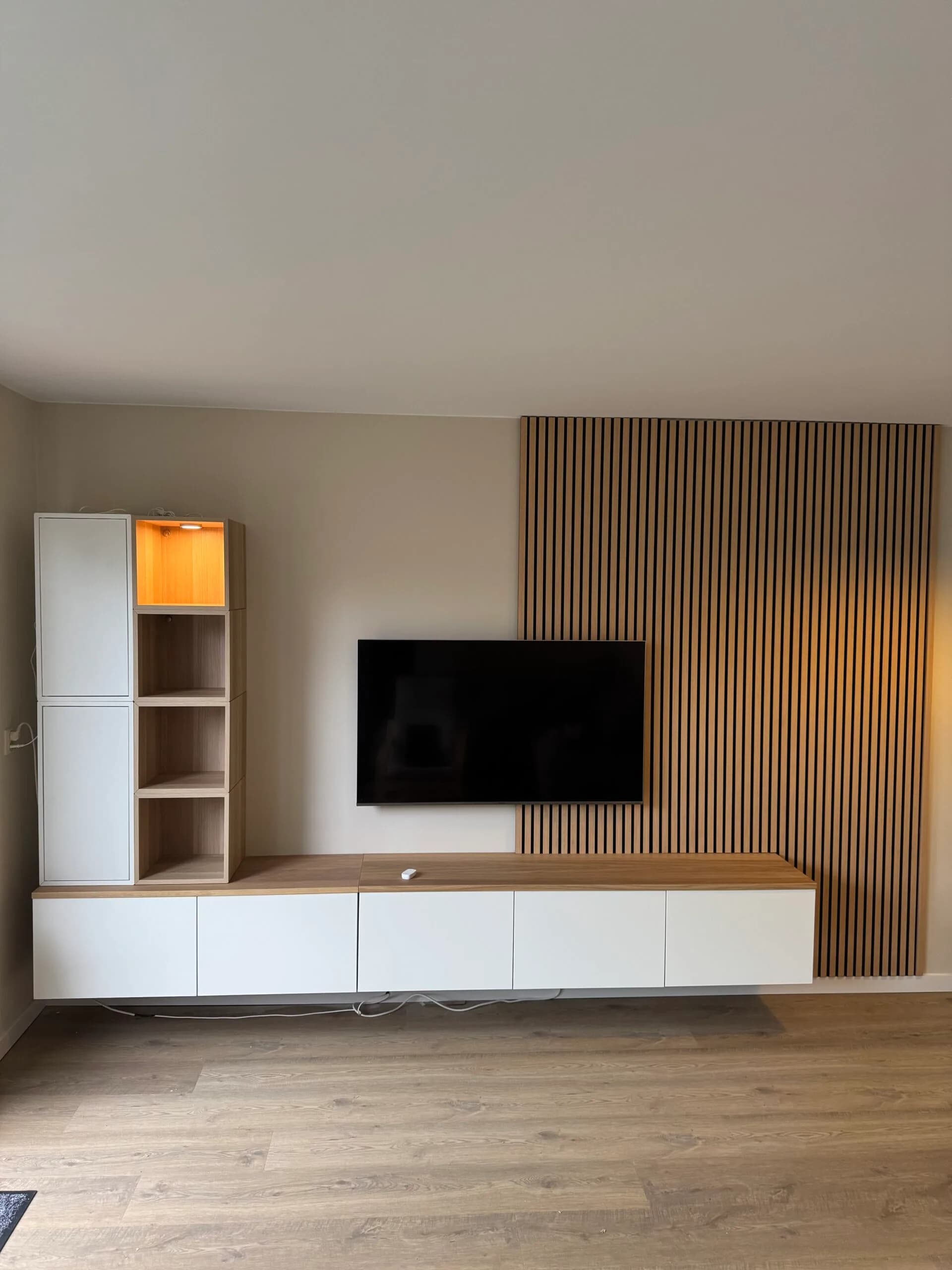
Wall-hung BESTÅ TV unit with a wooden top against a slatted wood wall, with a lit open unit beside it

IKEA assembly

BESTÅ TV unit assembly

BESTÅ in every configuration: floating on the wall, on legs or on a plinth.

Book an appointment

A BESTÅ wall is not a cabinet but an assembly: frames that must form one line, doors adjusted to within two millimetres, and a stack of equipment that needs power, signal and air. So we start with the cables and the wall, not with the furniture. A wall-hung run of two frames stands in about two hours; with a television bracket, cable penetrations and lighting it grows to half a day.

Scope of work

  • Floating mount

    BESTÅ floating on concrete, sand-lime brick or plasterboard — reinforced brackets for extra load.

  • Cables hidden

    Power and HDMI cables run through the wall, back panel or a cable channel — no messy snake under the TV.

  • Drawers aligned

    Drawers parallel to the millimetre, push-open tested, soft-close without a thud. Small detail, big difference.

  • Light integration

    NORRFLY or ÖVERSIDAN LED lighting with dimmer or motion sensor fitted inside the unit, cables finished out of sight.

  • TV bracket

    VESA bracket separate or integrated onto the BESTÅ — tested up to the specified TV weight, screws checked.

  • Glass and wood

    Glass or wooden fronts, push-open or classic handles — any configuration within the BESTÅ system.

Practical

Duration
2–4 hours per unit
Coverage
Across the Netherlands
Payment
iDEAL · card · invoice

At a glance

Everything that has to run behind a media wall, and how much room it costs. Count the depth of the plugs: a right-angled plug often saves exactly the centimetres that decide it.
What has to runWhere it comes fromRoom behind the unitWhat goes wrong
Power for the televisionSocket behind or beside the unit5–8 cm with a right-angled plugA straight plug pushing the unit off the wall
Coaxial, fibre or networkConnection point in the meter cupboard or room4–6 cm, plus the bend radiusFibre bent too tightly loses signal
HDMI to the screenReceiver or media player in the cabinetPenetration in the back panel, 5 cmCable too short once the height is marked out
Soundbar or subwooferOwn power supply plus signal cable8–10 cm with a soundbar under the setA power brick with nowhere to sit
Console chargersExtension block in the lower compartment10 cm for the block itselfBlock loose on the base, cables in the way
Cabinet LED lightingDriver on an ordinary socket3–4 cm plus room for the driverDriver built into a place that stays unreachable

Price

On request

Includes wall anchoring, cable management and push-open adjustment. TV bracket priced separately on request — fixed price up front.

BESTÅ TV unit with push-open doors adjusted

01 — Detail

Floating starts at the wall.

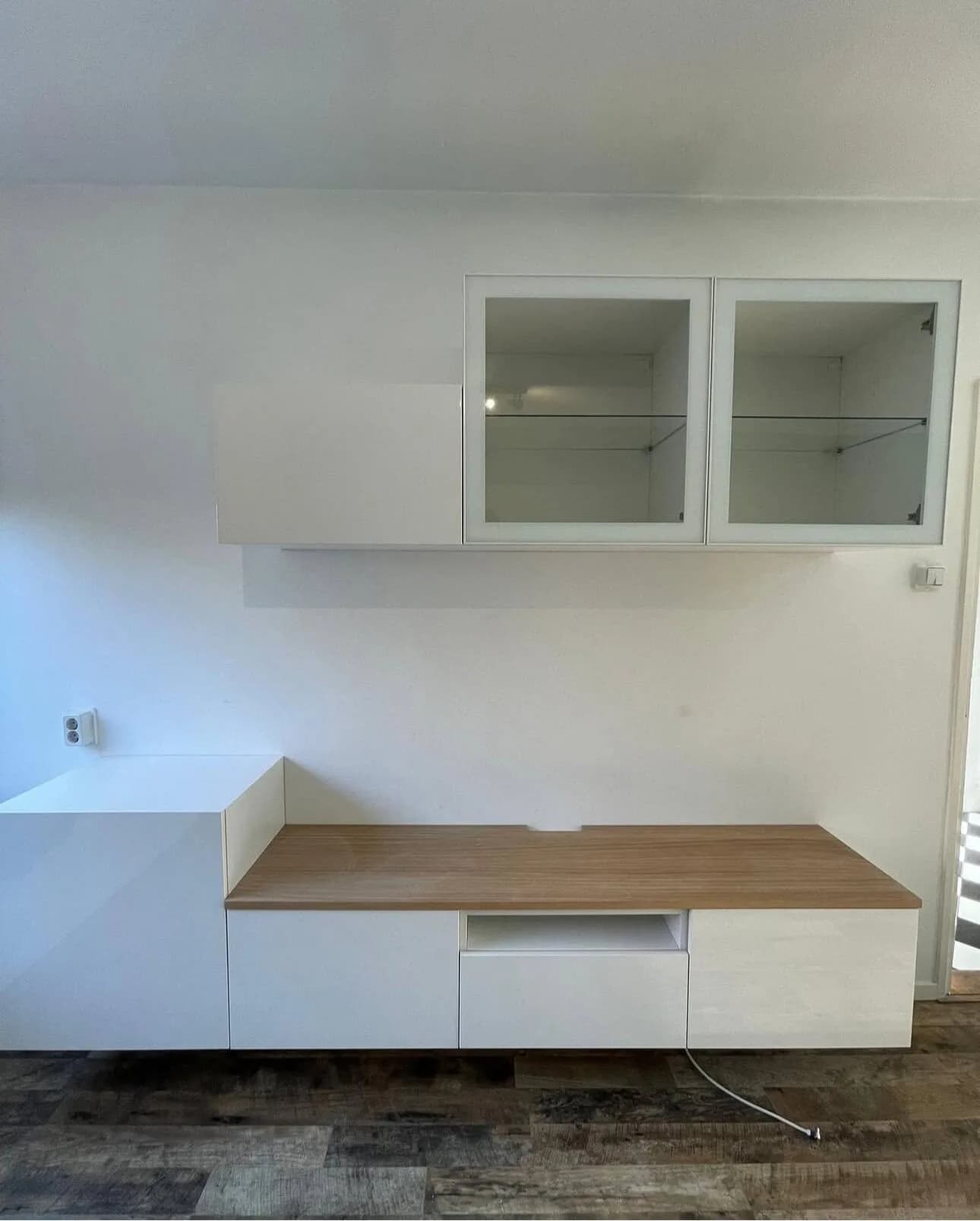
For a floating BESTÅ only two things matter: the right wall bracket and the right plug for the wall type. A plasterboard wall with only a cavity plug won't hold 60 kg; that needs a continuous batten or a screw into a metal stud underneath. We sound out the wall, choose the bracket, and only then lift the unit.
02 — Detail

Cables through the wall, not alongside it.

We drill a feed-through behind the TV and a second one in the back of the BESTÅ, and pull power plus HDMI in a single loop. Nothing visible on the wall; inside the unit the plugs go behind the cable flap in the back panel. The result is furniture without a dangling snake.

03 — Detail

Push-open is an adjustment, not a gamble.

A BESTÅ door that won't pop open, or pops out but doesn't click back, isn't faulty — it's a two-millimetre adjustment at the magnetic latch. We measure, test, and set each door so it opens with one light tap and closes with a finger.

On the job

Hanging clear of the floor, losing the cables and letting equipment breathe

A wall-hung unit is a lever

The weight of a BESTÅ does not hang directly under its fixings but forty centimetres in front of them. That pulls the top row of screws outwards while the bottom row is pressed against the wall — so the top carries far more than the weight suggests, and it gets worse as soon as the unit is filled with a receiver and games consoles. We therefore spread the load over more points than the manual demands as a minimum, and make sure the top fixing always lands in the strongest part of the wall. The same arithmetic applies to tall cabinets, see IKEA wardrobe assembly.

The height you hang it at is a decision

Wall-hung is not a fixed dimension. Hang it low and the wall reads calmer and you look straight at the middle of the screen from the sofa; hang it higher and you can vacuum underneath and a robot vacuum will pass. So we always ask how high you sit before marking out, because the centre of the picture belongs roughly at eye level in a seated position. If a skirting board or a heating manifold is in the way, that sets the lower limit. We mark the line with a level across the full width, not with a rule from the floor — the floor is rarely level.

Equipment needs air

A receiver, a games console and a media player all give off heat, and in a closed compartment behind a glass door that temperature climbs. The back panel of a BESTÅ has cut-outs meant for exactly this: we keep them clear and do not lay cables straight across them. Where a compartment is closed, we place the equipment so the hottest box sits at the top with room above it. That is not a luxury: equipment that runs too warm throttles back or spins its fan up, and you hear it precisely during a quiet scene.

The television bracket belongs to the wall, not the cabinet

A sixty-five inch television belongs in the wall, not in the chipboard of a cabinet. So we fix the bracket separately and check two things: the hole pattern on the back of the set and the stated maximum weight of the bracket. A tilting or swivelling arm adds one more: the set travels tens of centimetres away from the wall as it swings out, so the cables have to follow that movement without pulling tight. How we choose the fixing per wall type is set out under wardrobes of every brand.

Glass, drawers and the weight that goes in

A glass door weighs considerably more than a timber front, and that changes the adjustment: the hinges carry more, the door drops a millimetre sooner, and the damper must be set firmer. Drawers have a stated load rating that a stack of records or magazines reaches faster than you would think; an overloaded drawer starts to rub at the side and that wears the runner out. So we adjust the fronts only once the unit hangs fixed to the wall, because a frame that can still move gives every door a different gap. You meet the same adjustment in handleless kitchen fronts, see IKEA kitchen assembly.

Taking in the rest of the living room

A media wall rarely comes alone: there is often a sideboard, a bookcase or a set of shelves on the same wall. We combine those in one appointment, because then the wall only has to be cleared once, the cable holes are drilled in one go, and all the cardboard leaves in a single trip. We set an order in advance: first everything that goes on the wall, then what stands on the floor, and only at the end the cables and the equipment. For a whole room it works the same way, see office and living room assembly.

Sources

  • Living room with wall-hung TV unit, mounted and level
  • Living room with TV unit mounted wall-hung
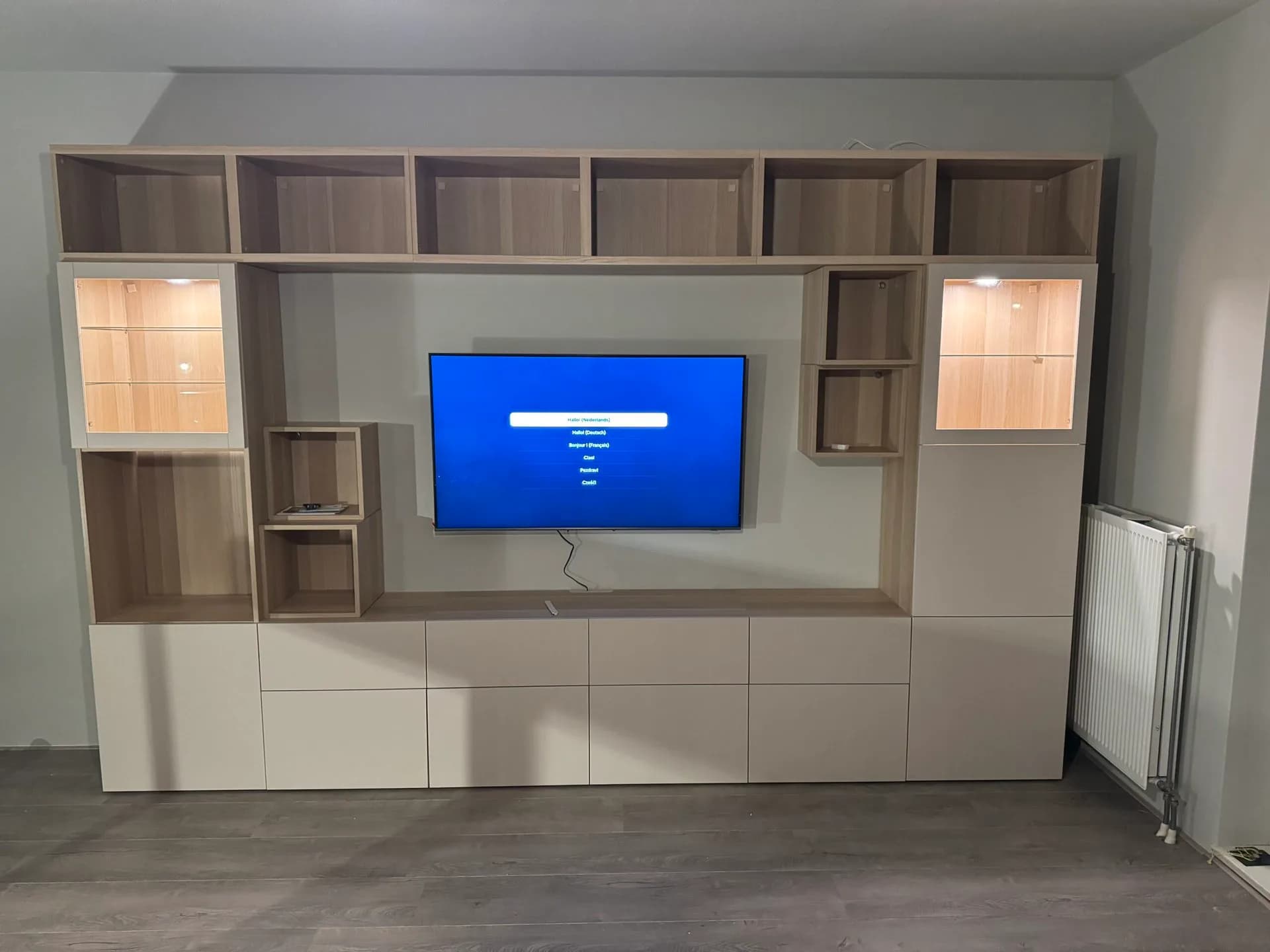
  • BESTÅ TV unit during assembly, frames level

Questions

Frequently asked questions

Can a floating BESTÅ also go on plasterboard?

Yes, provided we use cavity plugs or a continuous batten. We assess the wall on site.

Do you hide the cables behind a floating BESTÅ?

We drill one pass-through behind the TV and a second in the back panel of the BESTÅ, then pull power and HDMI through in a single loop. The plugs sit behind the cable flap in the back panel.

My push-open door will not click back. Is it faulty?

Usually not: it is a two-millimetre adjustment at the magnetic catch. We measure and set every door so it opens on one light tap and closes with a finger.

How high do you hang a wall-mounted television unit?

We decide that together, starting from your seated height: the centre of the screen belongs roughly at eye level when you are on the sofa. If you want to vacuum underneath or let a robot vacuum pass, we allow for that. We mark the line with a level rather than measuring up from the floor.

Do you mount the television itself as well?

Yes, on a separate bracket into the wall — not into the back panel of the unit. We check the hole pattern on the set and the stated maximum weight of the bracket, and with a swivel arm we make sure the cables can follow the movement. Installing new wiring is not part of our work.

What if there is no socket behind the unit?

Then we route the cable to the nearest existing socket, through the back panel and along the skirting or in a trunking. We do not add a new socket outlet; that is for a qualified electrician. We say so beforehand, so you can have it arranged before we arrive.

BESTÅ TV unit with push-open doors adjusted

Assembled within two weeks.

Send us your BESTÅ configuration — you'll have a fixed price within 24 hours.

Book an appointment

Last updated